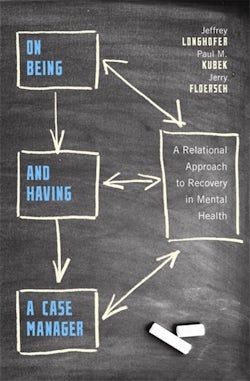
On Being and Having a Case Manager: A Relational Approach to Recovery in Mental Health
Jeffrey Longhofer, Paul M. Kubek, and Jerry Floersch
eISBN: 9780231525534
2010 (224 pages 6 illus. / 4 tables)
Available PDF Downloads
 Complete Book Download
(pages 1-256) Complete Book Download
(pages 1-256)
Table of Contents
(pages 7-8)
Acknowledgments
(pages 9-11)
Introduction: The Relational Method for Recovery
(pages 12-33)
1. Culinary Arts
(pages 34-99)
2. An Apartment of Her Own
(pages 100-145)
3. Disappearance
(pages 146-203)
4. Realizing the Promise of Case Management: A Relational Approach to Recover y
(pages 204-218)
Appendix 1: Research Methods
(pages 219-228)
Appendix 2: Relational Case Management Form
(pages 229-230)
Notes
(pages 231-238)
References
(pages 239-244)
Index
(pages 245-256)
|
On Being and Having a Case Manager: A Relational Approach to Recovery in Mental Health
On Being and Having a Case Manager stresses the importance of the process of building relationships in helping clients realize independent lives. Based on a two-year study of Marilyn and her case managers, this book emphasizes the intentional exchange of attention and information between case managers, clients, and others within the caring network and clearly outlines a practical method for all service providers, clients, family members, and close friends to follow.
Throughout the day, from moment to moment, relationships fluctuate among doing for, doing with, standing by for support, and doing for oneself. By observing Marilyn and her case manager, the authors prove the value of mutually and continuously monitoring these fluctuations within three primary domains-feeling, thinking, and acting-while carrying out daily activities. These findings show that managers are often stuck in doing-for modes of relating. Indeed, this may be one of the factors that contribute most to case manager and client burnout. While some clients with severe and persistent symptoms may, in fact, frequently require others to do-for, some like Marilyn may not require as much. They may need more doing-with and standing-by to encourage mastery and the internalization of confidence.
See below for our purchase options for this e-book. Individual chapters with a BUY button can be purchased for only $5, and any chapter with a FREE button can be downloaded or viewed online at any time.
Table of Contents
On Being and Having a Case Manager: A Relational Approach to Recovery in Mental Health
Author(s):
Longhofer, Jeffrey, Paul M. Kubek, and Jerry Floersch
Keyword(s):
SW07; SW11; CSWO
|